Tuesday, February 18, 2020

Journal 3 from Ian

In chapter the final chapter of the triggering town something that really stuck out to me was the the way that the people who worked at Renton, put a story to the squatter that was on the land. “The people at Renton who saw it brought me so many more facts and story’s that my imagination could never have handled it all.” (Pg 105). I liked this because it gave a face to the squatter that they were trying to kickoff there land. Some times it just takes a moment and a story for us to not judge a book by its cover.  Two of the biggest take always I got from the book where 1st you don’t need to take on a big project all at once you can work on it slowly over time. The 2nd thing that I took away from this book is that I should start creating writing rules for my self that I should run though daily or when ever I write.
This is a cartoon of a squatter, this might have been how the admiral lived. 

Journal 3 by Mitchel Hendricks

1. What was memorable was on the first page, where Hugo talked about what "the real world" meant. He also talked about how is a factory more "real" than college. Hugo also shares how in his time of working at college, he has had his share of ex-cons, victims of sexual assault and etc.

2. The first thing is don't take something big all at once, take it at small steps at a time. The second thing is you need to structure your writing instead of going head first into it. I know because when I started writing my book, I only had the idea of what I wanted the book to be about. I didn't plan it out or write out how long the chapters would be or what they would be about.

 Books, Head, and Memes: spend more time
 watching mu stories in
 my head than Writing
 them.
💢8⃣0⃣0⃣💢 • 📺Books📺 • This is totally me • ⇩Tags⇩ fandom books book reading read writing writer writersofinstagram captions tbh

journal 3- Steven Wappenstein


One Thing I noticed during the chapter nine reading was that even during poems that fell onto Hugo's lap he still had to invent reasons and motivations for characters in the poem such as:

"To him, a rainbow if oil might mean
a tug upstream, a boom, a chance a log
would break away and float his lasso."

This quote comes from Hugo's The Squatter on company land. Even Though Hugo had witnessed most of these events at work he still had to invent some reason as to why The Admiral did what he did, in Hugo's mind the Admiral wanted to get lucky when in all reality his motivation to live there could be he's in millions of dollars of debt to the IRS that he has no hope of paying off, or a whole host of other reasons other than this, but Hugo used this as a opportunity to create his own Admiral for the poem.


Image result for IRS
One major takeaway I got from the book was how to use triggering subjects to get meaning and value from the setting of a poem. This helped me a lot in the writing process because it helped me break a lot of writing block that I would have. I could rely on the setting in order to find some moral of the story or something of that sort.


I also think That Hugo had good advice about overusing certain words, some examples he said to limit your use of were: love, so and such, and although I did use some of these words I did try to challenge myself to not use other words like music.


Madalyn's Jounal #3

Madalyn Watts
English 2267

Journal #3

 The final chapter of The Triggering Town may very well have been my favorite chapter, simply because of the last paragraph.  In that final paragraph, Hugo says "We won't all disappear on a remote country road in the Monroe Valley, but like the Admiral and his wife we are all going into the dark.  Some of us hope that before we do we have been honest enough to scream back at the fates.  Or if we never did it ourselves, that someone,  derelict or poet, did it for us once in some euphonic way..." I think that everyone, no matter what they have done in their lifetime, thinks that they have lived their best possible life at some point or another.  They like to believe that they have never done anything so wildly reprehensible that they cannot be forgiven.  This really resonated with , because when I recently left high school, I noticed many many MANY people who think the same of themselves.  Which to a certain extent is normal, but boy, oh boy.  Too much is definitely too much. 

 One of my biggest takeaways from this book is that it's all about finding your triggering subject. You may sit sown with the intentions of writing a poem about a snowy day, but your triggering subject ends up being a canoe.  It definitely sounded funky to me before writing all of my poetry exercises but now that I have a few poems under my belt, I can absolutely vouch for this, once you find your subject, there is nothing stopping you from writing a phenomenal poem!  Another very big takeaway that I got from the book is that anyone, no matter what kind of background you have, can be a poet!  It made me feel better once I figured this out.  Because I am a perfectionist by nature (I picked up this wonderful trait from my mother)  This means that I get very frustrated when I put my pen to paper and poetry doesn't just flow out like a river.  But ive come to realize that no one has that skill!  It takes so so so much practice, and even the best of the best cant create canonical poetry in just one sitting.

Image result for flowing river 
I chose this image because after reading The Triggering Town, my personal river is flowing much better than it was before!

Journal 3 by Mikaela Marshall

Something that stood out to me from chapter nine of The Triggering Town was, “To be a poet you must live with an intensity five times, nay a hundred times more furiously than that of those about you. There is no scene, no experience which should not contribute to your poetic appreciations and culture” (Hugo 100). I really appreciated this quote for more than just writing. As someone going into the art field I felt this could be applied to that as well. I am constantly looking at the world around me and imagining the different ways to transform it into a unique work of art. This quote was a good reminder for my writing that I can apply my same artistic process into my writing.

One thing I took away from The Triggering Town was, “How you feel about yourself is probably the most important feeling you have. It colors all other feelings, and if you are a poet, it colors your writing” (Hugo 67). This takeaway also impacted me as a reminder to stay vulnerable on the page. I think being reminded to keep in touch with your emotions is clearly beneficial to writing, but beyond that is just a healthy way to take care of yourself. By being open and honest about your emotions creates enriched writing as well as some clarity in your life.

Another thing that impacted me in the book was the quote, “Writing is hard and writers need help” (Hugo 52). This was a helpful reminder that writing is not easy and won’t be done perfectly every time, and definitely not on the first try. It is ok to reach out to other writers and ask for both positive and negative feedback with your work. This helped write many of my poems because it reduced the pressure of trying to make a perfect poem by the due date.

Journal Three by Braeden Mills

“But no job accounts for the impulse to find and order those bits of yourself that can come out only in the most unguarded moments, in the wildest, most primitive phrases we only shout alone at the mirror” (Hugo, 109). To me, this quote kind of gave into the idea that writing can just happen to anybody at anytime and any place, but there's no calling when it'll happen to you.

One of the biggest takeaways I've gained from reading the book was the "No semicolons. Semicolons indicate relationships that only idiots need defined by punctuation" (Hugo, 80). One of my favorite things to incorporate in poems were my use of semicolons, so when Hugo stated this, I somewhat hated the statement at the moment but I understand that semicolons aren't necessary now. I also liked the quote above, basically reminding the reader that everybody will have hardships when writing, but on the other hand, your day will come. 

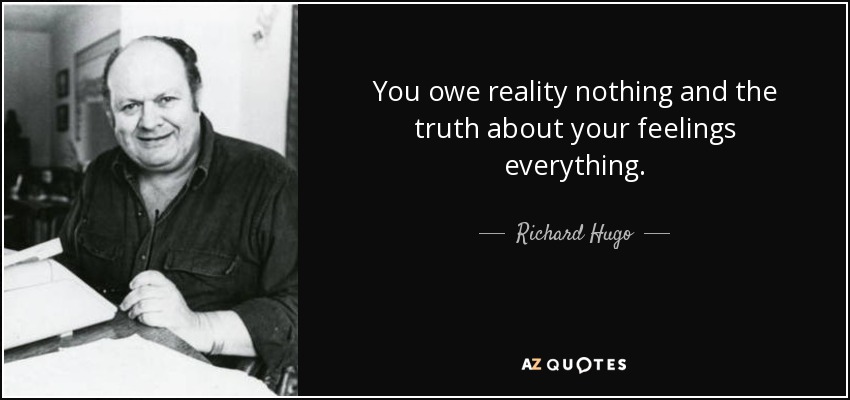
My favorite quote from Richard Hugo.

Journal 3 - Alex Harris

 In chapter Nine of The Triggering Town, one part in particular that stood out to me was when, on page 101, Hugo talks about having a hard time writing after working all day stating “...there’s a tendency to feel you've fulfilled your obligation to the universe. Why go home and write?” This is something that really resonated with me because after a full day of work or school, I also have difficulty finding the motivation to write or do things that I like. I think that it’s really important to remember that if you’re passionate about writing, not to let yourself avoid it because you don’t feel like it. Sometimes you have to dredge up your writing, otherwise you’ll never write, or finish, anything meaningful.
Something that stood out to me and that I will take away from this book was the idea of not restricting yourself unnecessarily. Hugo said that you need rules for writing to not be aimless, but don’t cling to them. Chapter Five: Nuts and Bolts has the best example of this when on page 43 Hugo writes “That is the advantage of making up rules. If they are working they should lead you to better writing. If they don’t you’ve made up the wrong rules.” In the past I have tried to follow writing advice from others, even when I found that it made it harder to write. For example, one piece of advice I was given was to write at least 100 words a day. When I was following this rule I found that I never liked what I wrote because I was writing to fill space as opposed to because I had ideas. In the future I will endeavor to experiment with writing rules, but allow myself to let them go if I find they aren’t working for me.
Another thing that I took away was his advice that writers must make assumptions about everything. In Chapter Three: Assumptions on page 19 Hugo writes “It is important that a poet not question his or her assumptions, at least not in the middle of composition. Finish the poem first, then worry, if you have to, about being right or sane.” This stood out to me because in my writing, I often get caught up on minor details. Instead of just stating something and moving on, I find myself delving into research to make sure to get exactly correct details that have little bearing on the story, and end up never getting to my original point. For example, knowing how different types of forests are layed out is all well and good, but hardly necessary to know in order to walk through one.
Theodore Roethke, the man who inspired the philosophy of rules only existing to help with writing in Hugo.

Journal Two by Braeden Mills

My name is Braeden Mills, this is my second year here at OSU Marion. I am currently an Economics Major looking to specialize in finance with hopes of becoming a financial advisor.

My fun fact was that I have 3 tattoos. My first was the waves tattoo on my forearm, then I got another on my chest of an infinite sign and interlocking hearts for my family, and roman numerals of my great uncle's passing date.

Journal #3- Summer Jordan

On page 109 in Triggering Towns there is a direct quote that is stated “But no job accounts for the impulse to find and order those bits of yourself that can come out only in the most unguarded moments, in the wildest, most primitive phrases we only shout alone at the mirror”.  This quote is memorable to me because I think it helps the reader to know that it’s not the job that can cause a person to really reflect on themselves and say some of the most vulnerable things they are facing, but it is everything leading up to that job.  Everyone has that “standing in the mirror” moment where one just stands there, thinking some of the deepest things, and those things come from time and experience, not just one job in itself.

One takeaway I have gained from this book is that there are young poets, such as myself, still have so much to learn.  Such as what the right amount of attention a certain matter should be given in a poem.  On page 32, Hugo states that young poets give too much attention to some certain matters.  I think this is a big lesson because focusing too much attention on one matter can break the poem as it can cause the reader to lose interest.  Another takeaway I will take from this book is as creative writers, we are lucky to have so many tools to help us in our writing, such as our vulnerability.  On page 55, Hugo says that as we are vulnerable people, we use that as a protection in our way of life.  This is a good lesson because it can help the reader to know that our vulnerability can help us in our creative writing.

Standing in in the mirror, reflecting internally and externally 

Journal Three-Max Balderson

I think that I was most interested to find that people would ask Hugo how working "in the real world" was different than working as a creative writing teacher. Me and Hugo both had very similar reactions to this. It's honestly a shocking and fairly insulting question to all academics. Hugo brings up direct comparisons between his two occupations, and I think it helps us to realize an important truth. That they both are work, and the both are very real and involved lines of work. Of course he is passionate about poetry but we learn that doesn't make his teaching job a dreamland.

Out of the whole book one of the most useful chapters, for me, was chapter 5 Nuts and Bolts. The about this chapter is that it is very tongue in cheek. If you use this chapter like a checklist in your poetry writing, then you probably haven't learned anything from it. I don't use a number 2 pencil when I write poetry. I use a mechanical one. Does it matter? I don't think so. The point of chapter 5 is that we are supposed to learn to place restrictions on ourselves. Be consistent if you want consistent results. I write in the same spot, with the same pencil, at the same time everyday now. You could say it sounds superstitious, but it's been making the river rise a lot more.

Image result for richard hugo
Richard Hugo being cool

Monday, February 17, 2020

Lindsay Euans- Journal Three

In Chapter Nine of "The Triggering Town", something that struck me as both memorable and important was, "Maybe hope that humanity will always survive civilization" (109). I thought this was powerful and phrase that stands time. I think many times people forget to look deeper into the human within people and remember that they are more than just students, teachers, employees, bosses, or CEOs. People will always be human first, and humanity should not be pushed aside. Hope may sometimes seem redundant and worthless, but is apart of what makes us human, and how we can better ourselves as society. This followed the letter from the man the company was trying to push off the land they wanted to build on. There are so many others like this man all over the world who have been taken advantage of by people with more power. The power is within the humanity of our world, those people and their stories matter.

One of my biggest takeaways from this book was that in order to write something potentially big, you have to start with that small triggering subject. This was helpful to me to remind myself that the small things overtime can add up to big accomplishments overtime. The mountain does not have to be conquered in one day. Small steps at a time can help to reach the end goal. Another takeaway that I had from this book, was just another reinforcement of the healing powers of writing and how you can go back to places from the past that may have troubled you and write it down and heal from it. I like to write as a mechanism for understanding and organizing, so this book was a good reminder of that, and the power and importance of writing in general.

Image result for mt hood
The mountain does not have to be conquered in one day

Journal 3 -- Ciera Yamarick

In chapter nine of The Triggering Town, Richard Hugo talked about his role as a poet and the impact that occupation can make. He recalls in the chapter that, 'Here, I am close to poetry's only consistent audience...And teaching gives me a personal satisfaction no there job ever did" (Hugo 109). This really resonated with me because, one, I really admire his love for sharing his talent to other people. Secondly, teaching people about certain things in life through poetry is an authentic and special experience. This can help people learn how to put words to their emotions while other outlets can't fulfill that same impact.  Not only teaching about the subject but writing poems can be a source of information that can help people to become more aware of different topics. The concept of teaching with poetry is really important as it can be used to inform and help people process their experiences.

The first memorable piece of advice that I took away from The Triggering Town was the idea of revision. He really goes in depth into the techniques in his chapter of "Nuts and Bolts", and more specifically he says that "Often you know something is wrong but out of fear or laziness you try to ignore it, to delude yourself that the poem is done" (Hugo 39). As a writer, I tend to write something then stick to it without much editing...which is a poor way of going about things. His encouragement to mess up and fix your work has been a very helpful piece of advice for me, personally. Additionally, his statement of impact that poets hold with their writing gives me another perspective on my role as a creative writer. He says that "One of our privileges as creative writers is that we are vulnerable people who hold jobs in an environment where self-protection is a way of life" (Hugo 55). Poetry is a way to express thoughts that may be too hard to process or be said. It's another perspective in a world of fact and poets have the opportunity to share insight in that world. Revision and learning the role of a poet has helped me the most from this book.


This is also one of my favorite quotes from Richard Hugo.

Sunday, February 16, 2020

Journal Three Dylan Pangborn

 I think one of the most interesting observations I had in Chapter nine of The Triggering Town was just how much importance Hugo put on poetry and being a poet. He makes it very clear that his life would not be complete should he find himself being a poet. The quote "But no job accounts for the impulse to find and order those bits and pieces of yourself that can come out only in the most unguarded moments, in the wildest, most primitive phrases we shout alone at the mirror." was very eye-opening to me because I think it speaks to a need we have as humans to let out emotions that we tend to bottle up. I think Hugo advocates art, be that poetry or not, is necessary for us because it provides a way of digging deep and facing those emotions.

One of my biggest takeaways from the book as a whole was that if you want to write about a big idea it is better to start with a small subject. I think even as I've been writing poems for class I find myself needing to dial back from a big idea and remember to start smaller. Sometimes we really want to tackle the world but it is important to have a place to start. Another big takeaway was that establishing rules for yourself while writing can be a very helpful way to get the best out of your writing. The entirety of chapter five was Hugo giving his personal rules while qualifying it by saying that these are rules he plays by but that you don't necessarily have to. I had never thought about imposing rules upon myself when writing but it makes a lot of sense since it could act to keep me a little bit more restrained in a positive way. Overall the book was a fantastic supplement to a more scholarly book because you just don't get the kind of raw lessons Richard Hugo gave out of a textbook.

Image result for richard hugo poet
Richard Hugo just living his life.

Friday, February 14, 2020

If any problems on Journal Three posting. . .from Mike Lohre

Students, the blog has been goofy this semester, and in my other class as well.

Let's just make the best of it.  It's a great tool when it works, but like much of technology, we tend to overdepend on it and it can often let us down. There's a lesson in that, too.  Welcome to Planet Earth.

If you have trouble posting or writing Comments, just do them in Word, print them out, and bring them to class.  I trust that any footdragging and immaturity in this class is a thing of the past.  As a whole, I trust you.

Look forward to your insights and conversation!

All my best,

Mike

p.s. I'd wish you a happy Valentine's Day but I don't believe in it; in my subjective opinion it's a manufactured holiday based not always on the true heart but manufactured peer pressure and consumerism.  Let your love shine every day might be a healthier cultural trend.


Thursday, February 13, 2020

Madalyn’s poem for workshop


Journal Two- Steven Wappenstein


   Hello All,


            My name is Steven Wappenstein and this is my blog! I was born in Columbus Ohio,
and spent a major potion of my childhood in the Sunbury/ Galena area. I graduated from Big Walnut High school in the spring of 2018. During high school I was a boy scout in troop 318, I also did science fair during my senior year of high school.

            From four Genre's in brief the concept that has helped me the most was about the use of the enjambment to create surprises for the reader. "The simple act of breaking a line causes a reader to pause, if only for a microsecond, in preparation for the next line. We digest what we have just read and ask ourselves, "What's coming next?" Then we move our eyes down the page to learn if our expectations will be confirmed or confounded." I have been able to use this in my own poetry and feel that it makes things interesting and makes the reader more inclined to continue reading because I know from my own experience that if the poem does not in someway grab someone's attention it will slowly and surely lose their attention and they will eventually stop reading.

Thursday, February 6, 2020

Journal 2 for Madalyn Watts


Journal 2


My name is Madalyn Watts, I am a freshman at The Ohio State University Marion Campus, and I am majoring in Dental Hygiene.  A fun fact about me is that I can speak fluently in Spanish, I have been studying the Spanish language for 8 years.  I began in the 5th grade and continued until I graduated high school.  I was very close to minoring in Spanish as well, but I decided that one major would challenge me enough.  Believe it or not, I use my speaking skills quite often.  They allow me to adapt to an increasingly diverse society which I am very grateful for!  I am very excited to see where this new chapter of my life takes me to and all of the new people I meet along the way.  


From Four Genres In Brief, I would definitely say that the terminology and the anatomy of a poem has been the most helpful to me.  From different forms to the use of white space in a poem, to different terms like enjambment and scansion.  These new elements of poetry, while they are very new and sometimes a bit confusing, they allow me to expand my knowledge of poetry.  More specifically, they allow me to contribute more to class conversations and analyses.  I even find myself using these terms and concepts in other classes, which allows me to get a foot in the door when I comes to discussions.  Also, one particularly helpful piece of advice that I have taken away thus far is “Ultimately, the only real way to become a poet is to keep writing poems - lots of them - most of which you’ll end up throwing away.”  This gave me a great sense of relief, because I always read poetry and felt jealous that people actually had thing like this floating around in their brains.  I was afraid coming into this class that I would be the least poetic, clumsy writer, and that nothing profound would ever come from my poetry.  But now I know that these world renowned pieces of poetry have been revised countless different times and critiqued even more.  In my mind, there is no such thing as a perfect poem, there is always something to improve upon.   But I find great happiness in the fact that no one will ever write a great poem the very first time.

Tuesday, February 4, 2020

Journal 2 - Alex Harris

Hello everyone!
My name is Alex Harris, and I am a Second Year student at Ohio State. My major is undeclared, although I am looking into declaring as an English major. In my free time, I like to  I enjoy writing, although reading is my real passion, and my favorite genre is fantasy. In this class I hope to better my writing as well as improve upon my creative process.

One concept that I've found really helpful for writing poetry is enjambment. Whenever I would attempt to write poetry or other shorter forms of writing, I would always try to finish the sentence within each line, and that meant that I struggled to conform to formatting. In Four Genre's In Brief, we read that "In contrast to a poem that is heavily end-stopped, a poem with run-on or enjambed lines, tend to move more quickly down the page."(26). This concept has allowed me to much easier allow the lines of my poems to flow from one idea to the next.

Journal 2- Mikaela Marshall


My name is Mikaela Marshall, I am currently in my second year of college with a major in art education and a minor in art therapy. With this goal I have two big dreams that I hope to do with my life. One of these dreams is to teach children how to use their creativity through their artwork and inspire in all of them to use this artistic creativity throughout their life. My other dream is to help people dealing with difficult situations to cope with anxiety, or even trauma, using art. 


One of the most helpful tips to me from the Four Genres in Brief has been the advice to make time in my everyday routine to write. “The first and most important thing you have to know about writing ,’ according to Walter Mosley, “is that it is something you must do every day (Starkey 3). This was a great reminder and encouragement for me. I love to write but often find myself making excuses that I don’t have time in the day to do so. This encouraged me to incorporate writing into my everyday routine, even if it was only journaling for twenty minutes.

Journal 2 - Ciera Yamarick

Hello everyone, my name is Ciera Yamarick! I grew up in Powell and went to Olentangy Liberty High school until I ended up here in Marion! I currently live with my best friend Mikaela at the Annex, and we’ll be transferring to the Columbus campus next year. I’m majoring in Visual Communication Design (which is basically Graphic Design) with hopes of being a graphic designer out of college! As you may have seen, I love art. I draw, paint, and take pictures (I’m a photographer for my church in New Albany)! I also love to write, hence me signing up for this class. I’m currently writing a story, which has helped me grow more and more in my writing. Aside from all of that, I am the youngest of 5 girls in my family; I have triplet sisters that are 23 years old and another sister who’s about to turn 29! One of the triplets, Christina, took me to Europe for a month this summer. We went to London, Paris, Nice, Monaco, Helsinki, Copenhagen, then New York City on the way home! I love to travel and I would love to do more in the future. I’m excited to continue this semester and improve my writing abilities!

Though it may be easy to use this quote due to its location in the book, it’s one that has stuck with me. David Starkley writes in his beginning chapter that “Everyone has the capacity to write, writing can be taught, and teachers can help students become better writers” (Starkey 2). I have been in many english classes where the teachers don’t encourage their students on their strengths. They rather capitalize on their weaknesses as writers, which is very discouraging while you’re building your writing skills. This quote, however, helps me to understand that it is possible to be a writer and everyone has the capacity to do so. A teacher doesn’t have to dictate whether you can be a writer or not, and one person doesn’t have more opportunities than another with writing. I can become confident with improving my writing abilities, and that I don’t have to be discouraged in that fact because the place I’m in as a writer.